
STORIES OF SALIGRAM ARYAL
FROM PORTER TO FOUNDER
My thirty-year journey from a fourteen-year-old porter to the founder of Mountain World Treks and Expedition.
My Journey from Porter to Founder

My name is Saligram Aryal, founder of Mountain World Treks and Expedition. I started working in these mountains in 1996, when I was fourteen years old. Thirty years have passed since then, and I am still here, still working in the same mountains.
I am from a rural part of Dhading district in Nepal. There was no trekking or tourism in my village. There were rice fields, buffalo, long walks to school, and not much money. That was simply how life was. After Grade 10, I came to Kathmandu to continue my studies. I did not come thinking about mountains or trekking. I came because that was what people from villages did after school. Go to the city, try to study, and try to find some work.
A relative changed my plan. He knew someone in a trekking company and asked if I wanted to work as a porter. I said yes because I needed work. That was the only reason. I had no idea then that this simple decision would become the beginning of the work I have done for the next thirty years.
Saligram’s first time on a plane. He is getting on a small airplane at the Jomsom airport to fly to Pokhara. Mountains are in the background.
My First Trek as a Fourteen-Year-Old Porter

My first trek was in 1996, a five-day Poon Hill trek with Langtang Ri Trekking. I was fourteen years old. I did not know what carrying a porter’s load would feel like until they put it on my back. There was about twenty litres of kerosene, two kerosene stoves, two kerosene lamps, a toilet tent, and my own bag. The total load was around 35 kilos. I carried it with a rope across my forehead, as many porters did at that time.
We started climbing to Ulleri on the first day. Those stone steps seemed to keep going up and up. My neck was hurting and my legs were shaking. Somewhere on those steps, I started crying while I walked. It was tears and sweat together. Nobody noticed because everyone was busy carrying their own load.
I was paid 80 rupees a day, so five days meant 400 rupees in total. At the end of the trek, one of the trekkers gave me a 100-dollar tip. I did not understand how much that was in Nepali rupees at first. I had to ask someone.
I did four more treks that year. In 1997, I did more than ten, and in 1998 I did about the same again. I cannot remember the exact number now, but by then my shoulders were slowly getting used to the weight and my legs were getting stronger. I was also learning the trails, the villages, the teahouses, and the way trekking worked. I did not know it at the time, but those first few years were teaching me much more than how to carry a load.
Learning English So I Could Become a Guide

My biggest problem was not the mountains. It was English. I could not speak one full sentence. Foreign trekkers would ask me something and I understood very little. Sometimes I just nodded my head and hoped I had guessed correctly. Sometimes I guessed wrong, and I could see the confusion on their faces. I knew that if I wanted to become a guide one day, I had to learn the language.
I bought some old secondhand English books because they were cheap. I also bought a mirror. In the evenings, after work, I closed my door and stood in front of that mirror talking to myself. I spoke broken English, sounded out words I barely understood, and repeated sentences until I could say them better. Someone walking past my door probably would have thought I had gone mad.
On the trail, I listened carefully to how the trekkers spoke to each other. I noticed the words they used and tried to use those same words on my next trek. Little by little, I understood more, then I could answer simple questions, and later I could explain things about villages, trails, weather, and mountains.
It took time. My English was not perfect when I started working with trekkers as a guide, and it is still not perfect today. I still make mistakes, but I learned enough to talk to trekkers, understand their concerns, and explain what they needed to know.
From Porter to Licensed Trekking Guide
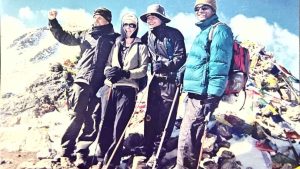
I worked as a porter from 1996 to 2000. During those years, I learned the trails, the villages, the teahouses, and what trekking work was really like. I was also learning English because I wanted to take the next step and become a guide.
In 2001, I started working as a porter cum guide, taking on some guiding responsibilities while still doing porter work. I continued this work into 2002. It was an important period for me because I was learning how different the responsibility of a guide was from carrying a load.
In 2002, I completed my guide training and received my guide licence and certificate from the Ministry of Culture, Tourism and Civil Aviation. Getting the training and licence was not easy for me because I did not have much money at the time.
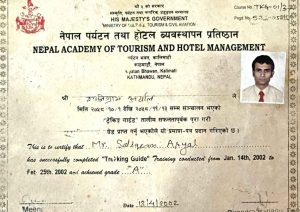
A friend from Slovenia named Stanko helped me. I had worked as his porter on an earlier trek, and he paid the training cost himself. He never asked me to pay him back. I still remember that kindness.
Becoming a licensed guide changed my responsibility completely. As a porter, my work was mainly about carrying my own load and getting it where it needed to go. As a guide, I was responsible for the people walking with me.
I had to know when someone was too tired to continue, when the weather was becoming unsafe, and how altitude was affecting different people. I had to make decisions that could affect the whole group. I began to understand that guiding was not simply walking in front of trekkers. It was taking responsibility for the people behind me.
Ten Years of Learning from the Mountains and Trekkers
From 2002 to 2010, I worked as a licensed trekking guide with two different trekking companies. I wanted to see as much of Nepal as I could, so I worked in Everest, Annapurna, Langtang, Manaslu, and other regions.
Some seasons were very busy. One trek would finish and another would start soon after. I spent much of those years on the trails, and every season taught me something new about people and about the mountains.
No two trekkers walk the same way. Some people are strong from the first day, while others struggle from the first few hours. Someone who looks very fit can have trouble with altitude, while someone who walks slowly at the beginning can become one of the strongest people in the group.

I learned to watch small things. How someone was walking, how often they stopped, how they were speaking, whether they were eating, whether they were sleeping, and how they were breathing.
People do not always tell you when something is wrong. Sometimes they hide a headache because they do not want to slow the group down. Sometimes they say they are fine because they think they should be able to continue. A guide has to notice these things.
I also learned by watching the companies and people I worked with. I saw how different companies treated guides and porters. I noticed what I respected and what I did not. Those experiences stayed with me. They helped me understand what kind of company I wanted to build if I ever had the chance to start one myself.
Starting Mountain World Treks in 2010
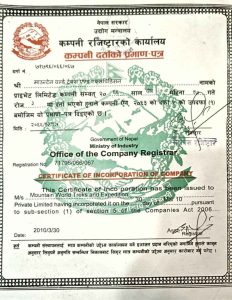
In 2010, I started Mountain World Treks and Expedition. There was no big office, no big team, and no large investment behind me. I started with what I had: the trails I had walked, the experience I had gained, and the trust I had built with clients over the years. I wanted clients to know exactly who was responsible for their trip.
When they arrived in Kathmandu, I did not want them to feel that they had simply been handed over to someone they had never met. I wanted to be involved and know what was happening throughout their journey.
In the beginning, almost every booking came through recommendations. One client told a friend, that friend told another person, and slowly more people came to know about us. There was no advertising. The company grew slowly, and some years were very slow, slower than I wanted, if I am honest. But when someone returned to Nepal with a friend or sent another client to us, I knew that the work we were doing was earning trust.
By 2012, the number of bookings had grown beyond what I could handle alone. I started bringing other guides into the company. That was when Mountain World Treks stopped being just my own work. It became a team, and I had a new responsibility.
I was no longer looking only after my own clients. I was also responsible for the people working with me and for the way we treated the clients who trusted us.
Why I Treat Porters as Part of My Team

I have not forgotten what it feels like to carry a heavy load up a mountain. That experience has shaped the way I work with porters today. The porters who work with me are part of my team. I do not see them only as people carrying bags.
On the trail, I eat with them, sit with them in the evening, and play cards with them when there is time. When a teahouse is full, I have shared a room with them and, at times, even the same bed because there was nowhere else to sleep. If someone needs warm clothes or socks and I have something they need, I give it to them.
I know what it feels like to be cold at altitude. I know what it feels like when your shoulders hurt and you still have several hours of walking ahead. I also know how much a porter contributes to a trek. A trekker may spend more time talking with the guide, but the porter is often carrying the things that make the trek possible. I do not want the people working with me to feel that their work is invisible.
The 2015 Earthquake at Annapurna Base Camp

I have worked through many difficult days in the mountains. There have been snowstorms that kept us at Everest Base Camp for days at a time. There have been strong winds where it was difficult to hear someone standing only a few metres away. But nothing prepared me for April 2015.
I was leading an Annapurna Base Camp trek with twelve trekkers and the full crew. We had just finished lunch at Machhapuchhre Base Camp and were preparing to walk the final two hours toward Annapurna Base Camp. Everyone was in a good mood. We were close to our destination and were talking about reaching the base camp.
Then the ground started shaking.
Rockfall began around us. There was an avalanche somewhere nearby. People were shouting. Some were crying. Some were standing still because they did not understand what was happening. I had twelve trekkers and the whole crew with me. I do not remember thinking through a clear plan at that moment. I remember acting.
I kept everyone together, watched the slopes above us, and counted the people. Then I counted them again and again because I needed to know that nobody was missing.
After the earthquake, we had no phone signal. We did not know what had happened in Kathmandu, and we did not know whether our families were safe. For several hours, I was responsible for the group while also wondering about my own family. That uncertainty was harder for me than I expected.
Eventually, we managed to get through on a phone and I heard that my family was safe. I could breathe again.
We decided to turn around. We did not continue toward Annapurna Base Camp just for the view. Everyone needed to get back safely. We walked down toward Pokhara, and eventually every person in that group returned to their own family.
I have completed many treks since then, but that day still sits differently from all the others.
What Being a Guide Has Taught Me?

People sometimes ask me what the most important job of a guide is. For me, the first responsibility is safety. A guide needs to keep people safe and help them enjoy the trek, including the difficult days.
Trekking is not easy, and it should not be presented as if it is. Altitude can make a strong person sick without much warning. Weather can change quickly. A trail that was easy in the morning can become difficult later in the day. Legs become tired, and sometimes the mind becomes tired before the legs do.
A good guide watches these things even when the client says nothing. I tell every guide who works with me not to wait for someone to complain. Look at their face. Watch how they walk. Ask simple questions.
A client may hide a headache because they do not want to be the reason the group stops. I have seen this many times. A guide has to notice these things and make the right decision before a small problem becomes a serious one.
Safety is not the only responsibility, though. A guide should also help a client understand where they are. Explain why a village is located where it is. Explain the name of a mountain when you know its story. Talk about the people who live along the trail.
Sit down and share tea when there is time. Listen when a client wants to tell you something. Sometimes that conversation matters more to a person than the trail itself. That is also part of guiding.
Thirty Years Later, I Am Still Walking the Trails

Today, Mountain World Treks works with around ten guides and about twenty porters. We work across Everest, Annapurna, Manaslu, Langtang, and other regions of Nepal. We also arrange climbing trips, helicopter tours, and journeys to Tibet and Bhutan.
The company has grown much more than I imagined when I started, but the work itself has not changed as much as people might think. I still go on treks myself. I still want to see the trail conditions, meet the people working along the route, and spend time with trekkers.
Running a company has changed my responsibilities, but I have not stopped being connected to the mountains. I started as a fourteen-year-old porter because I needed a job. I learned English because I wanted to become a guide. I became a guide because I wanted to take responsibility for the people walking with me. I started Mountain World Treks because I wanted to build a company from the things I had learned on the trail.
What the Mountains Have Taught Me

Thirty years later, I am still learning. I started in the mountains as a fourteen-year-old porter because I needed a job. I never imagined then that those first five days on the trail would become my life’s work.
I have carried loads, learned English in front of a mirror, become a guide, started my own company, and walked through some very difficult days in the mountains. The work has changed over the years, but the things I believe in have not.
Know the mountains properly. Look after the people walking with you. Treat the people working beside you with respect. Do the work honestly, every day.
I started with one load on my back. Today, I carry a different kind of responsibility. I am grateful that the mountains became my work and that I have had the chance to spend so much of my life here.
That is my story. That is all I know.
Ready to Experience
Nepal?
Join over 3,000 trekkers who've trusted Mountain World Treks to guide their Himalayan adventure safely and unforgettably.
Our Registrations & Memberships

Government of Nepal
Registered tourism company

TAAN
Trekking Agencies Association

Nepal Tourism Board
Authorised tour operator

NMA
Nepal Mountaineering Association
TripAdvisor Excellence
Certificate of excellence

45+ Countries
International travelers